Stemonitis spp.
Scientific name: Stemonitis Gled.
Derivation of name: Stemon means "thread" and
itis means "named after or pertaining to."
Common name(s): Chocolate tube slime; Tree hair;
Pipe cleaner slime.
Phylum: Myxomycota
Order: Stemonitales
Family: Stemonitidaceae
Occurrence on wood substrate: Clustered on dead
wood
and leaves; May through October.
Dimensions: These slime molds are 1-1.5 mm wide
and up to 2 cm tall.
Description: The brownish, cylindrical top portions
(sporangia) are supported by narrow, black stalks.
Comments: Chocolate tube slime looks like brown
hairs growing on
wood. While not fungi, slime molds
often form
spore-bearing structures
that resemble
those of the true
fungi. Although
many slime mold
species fruit on wood they do not
form a
penetrating
and absorptive mass of hyphae in the wood
substrate.
Rather, slime
molds form structures called plasmodia
which are naked (i.e., without cell walls) masses of
protoplasm which can move and engulf particles of
food in an amoeboid
manner. Slime mold plasmodia
creep about over the surfaces
of materials, engulfing
bacteria, spores of fungi and plants,
protozoa, and
particles of nonliving organic matter. At some
point,
plasmodia convert into spore-bearing
structures. In
Stemonitis, the plasmodium
converts into a
clustered
mass of stalked sporangia.
More information at MidwestNaturalist.com
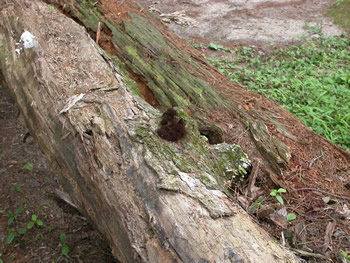
Figure 1. A very large fruiting of Stemonits on a log.
The wood serves as a platform on which the plasmodium
forms numerous stalked sporangia.
Photo © Gary Emberger.
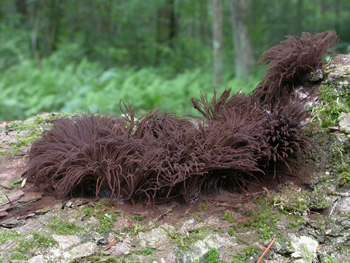
Figure 2. A closer view of the specimen in Figure 1.
There are very many individually stalked sporangia
clustered together in this fruiting.
Photo © Gary Emberger.
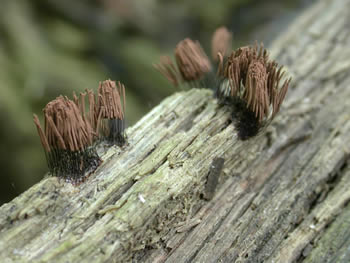
Figure 3. A smaller, more typical cluster of sporangia.
Photo © Gary Emberger.
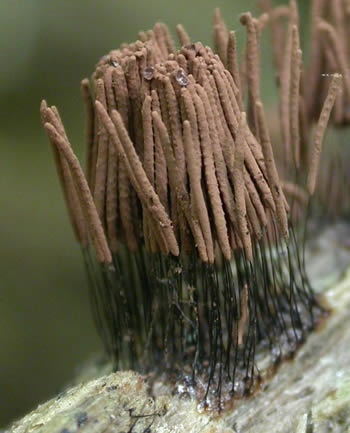
Figure 4. A close-up of one of the clusters of sporangia in
Figure 3. Each sporangium is supported by a narrow, black
stalk.
There are several species of Stemonitis. They vary in
relative length of the stalk and in microscopic details such
as spore morphology. Photo © Gary Emberger.
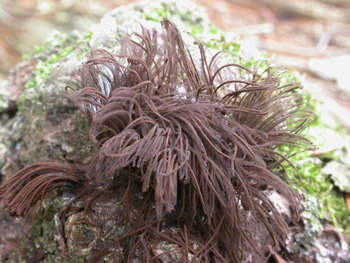
Figure 5. The stalked sporangia are spore-dispersal
structures. The sporangia become lighter in color as they
lose their dark brown
spores. Photo © Gary Emberger.
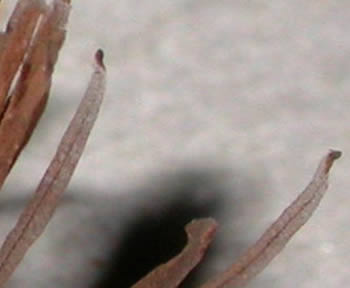
Figure 6. Appearance of the sporangia following release
of the spores. Attached to a central columella is a
network of capillitial threads.
Photo © Gary Emberger.
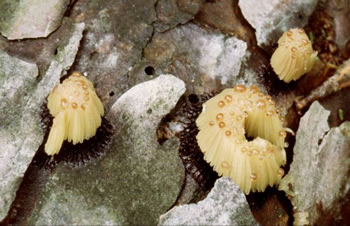
Figure 7.
Immature sporangia. Photo © Steve Nelsen.
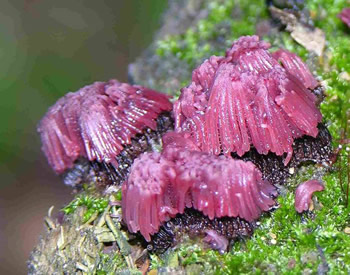
Figure 8. Immature sporangia. Photo © Steve Nelsen.
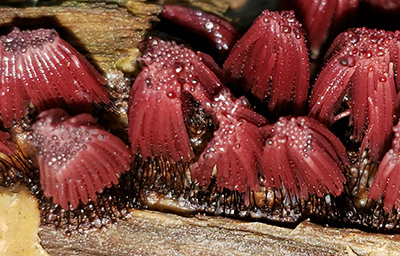
Figure 9.
Further development of immature sporangia.
Photo
© Linda Sears.