Leucopholiota decorosa
Scientific name: Leucopholiota decorosa (Peck) O. K.
Miller, Jr., T. J. Volk & Bessette
Derivation of name: decor- means elegant.
Synonyms: Armillaria decorosa (Peck) A. H. Smith,
Tricholomopsis decorosa (Peck) Singer, Agaricus
decorosus Peck
Common name(s): Decorated Pholiota.
Phylum: Basidiomycota
Order: Agaricales
Family: Tricholomataceae
Occurrence on wood substrate: Saprobic; single to small
groups on decaying hardwood stumps and logs; late
summer and fall.
Dimensions: Caps 2.5-6.5 cm wide; stipes 2.5-7.0 cm long
and 0.6-1.2 cm thick.
Cap: Surface covered with rusty brown, pointed, erect
and recurved scales.
Gills: Attached; white; edges uneven
or finely scalloped.
Spore print: White.
Stipe: Equal or enlarging toward base; smooth and white
above ring zone; covered with rusty brown, pointed,
recurved
scales below ring zone.
Veil: Coarse, rusty brown fibrils flare upward and form
a ring zone.
Comments: Many published photographs
of this
species
show the scales to be abundant and quite erect,
giving
the mushroom a very textured appearance. The scales on
the specimens I found were somewhat flattened, perhaps
due in part to age or the flattening effects of rain.
More information at MushroomExpert.com
More information at TomVolkFungi.net
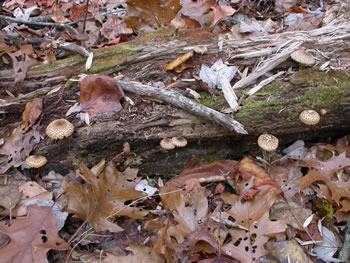
Figure 1.
Leucopholiota decorosa growing on a decaying
birch log late in the fall (November 9). Photo © Gary
Emberger.
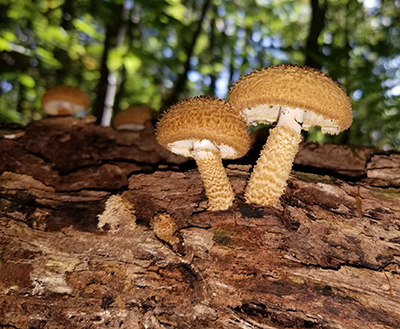
Figure 2.
Caps and lower portions of stipes covered with
rusty brown, erect, pointed scales.
Photo © George Morrison.
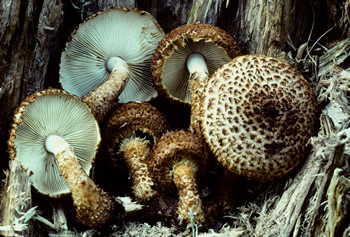
Figure 3. Leucopholiota decorosa. Photo © John
Plischke III.
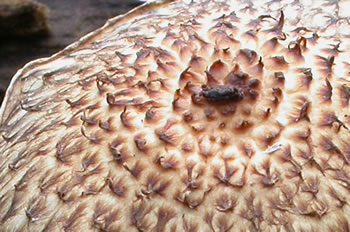
Figure 4.
The scales on Leucopholiota decorosa are erect
and bent backward (recurved) toward the center of the cap.
Photo © Gary Emberger.
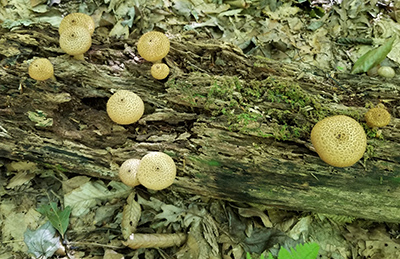
Figure
5. Viewed from above, Leucopholiota decorosa may
resemble a puffball, with the dark central cap scales
mimicking a puffball ostiole. Photo © George Morrison.
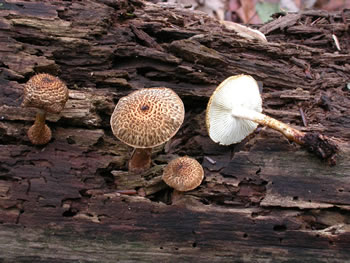
Figure 6.
The gills are white at maturity. Leucopholiota
decorosa has white spores. Similar looking Pholiota spp.
have brown spores. Photo © Gary Emberger.
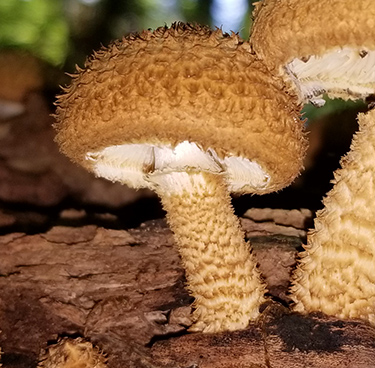
Figure 7. Fibrils flare upward and form a ring zone. The
stipe is smooth above the ring zone.
Photo © George Morrison.
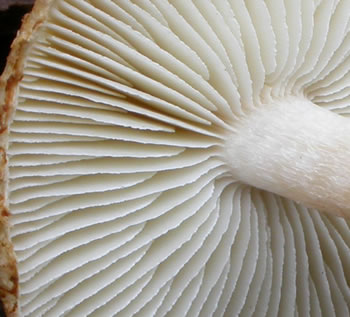
Figure 8.
Gills are attached to the stem. Because there is a
distinct notch in the gill just before its point of attachment to
the stem, this form of gill attachment is sometimes called
adnexed. Note the uneven or finely scalloped gill edges.
Photo © Gary Emberger.