Marasmius rotula
Scientific name: Marasmius rotula (Scopoli:Fries) Fries
Derivation of name: Marasm- means "withered" or
"dried out" in reference
to the manner in which its fruit
bodies dry out but can be rehydrated. Rot- means "wheel"
referring to wheel-
like appearance of the cap and widely
spaced gills.
Synonym: Agaricus rotula Scop.
Common name(s): Pinwheel Marasmius; Horse hair fungus;
Little wheel.
Phylum: Basidiomycota
Order: Agaricales
Family: Marasmiaceae
Occurrence on wood substrate: Saprobic; in clusters on dead
deciduous wood such as twigs and moss-covered logs and
stumps; May thought October.
Dimensions: Caps 3-20 mm wide; stipes 1.5-8.5 cm long and
0.3-1 mm thick.
Cap: White to yellowish; convex with a navel-like central
depression; flesh very thin.
Gills: Whitish; attached to a collar which surrounds the stalk.
Spore print:White.
Stipe:Whitish near the apex but mostly reddish-brown to
blackish; shiny, smooth, and hairless.
Veil: Absent.
Comments: As with most Marasmius species, Marasmius
rotula is able to dry down and then revive with rain, making it
seem to appear overnight.
More information at MushroomExpert.com:
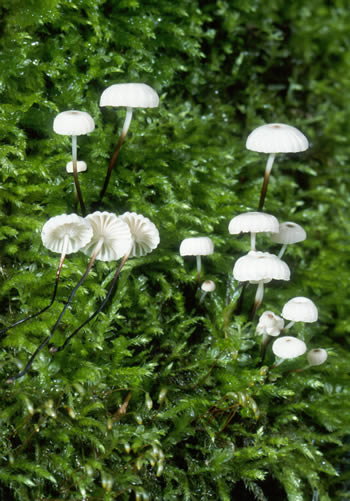
Figure 1. The pinwheel marasmius in a mossy habitat.
Photo © William Roody.
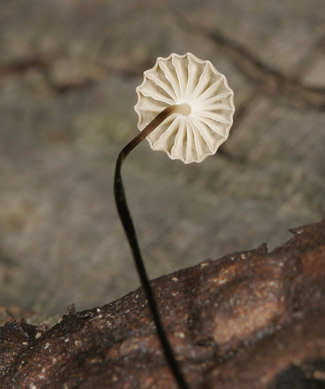
Figure 2. Note the widely spaced gills and the long,
narrow stipe which is quite dark except at the
apex.
Photo © Dianna Smith.
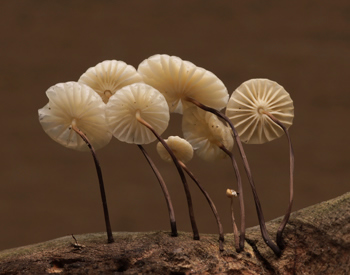
Figure 3. Pinwheel marasmius typically grows in clusters
on deciduous wood. Photo © Al Simpson.
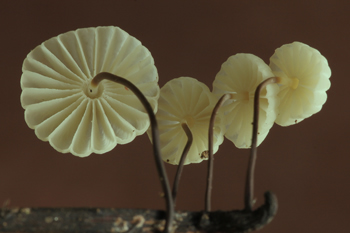
Figure 4. Many of the more interesting
features of this
mushroom are observable only from below. For example,
one of the diagnostic features for Marasmius
rotula is the
manner in which the gills are
attached to a collar (collarium)
which may be free from the
stipe or collapsed up against
it.
The collar is quite evident
in the specimen to the far left.
Photo © Al Simpson.