Plicaturopsis crispa
Scientific name: Plicaturopsis crispa (Pers.) D. A. Reid
Derivation of name: Crisp- means "curly" or "crisped"
referring to the crimped or crisped gill-like folds or perhaps
the undulating cap margin.
Synonyms: Trogia crispa (Pers.) Fr.
Common name(s): Crimped gill
Phylum: Basidiomycota
Order: Agaricales
Family: Incertae sedis
Occurrence on wood substrate: Saprobic; in overlapping
clusters on decaying branches and trunks of deciduous
trees; year-round.
Dimensions: Caps 1-2.5 cm wide.
Cap: Concentrically zoned with yellow-orange, reddish-
brown, and yellow-brown zones; tomentose; margin
undulating.
Gills: What appear to be gills are better understood as
gill-like or vein-like folds or wrinkles. They may be forked.
Spore print: White.
Stipe: A very short, rudimentary extension of the cap or
absent.
Veil: Absent.
Comments: The wrinkled gill-like underside is very
distinctive.
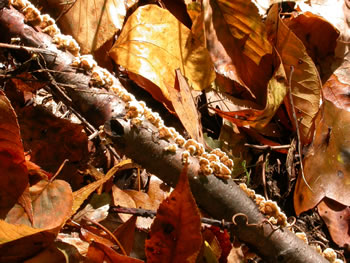
Figure 1. Clusters of overlapping caps of Plicaturopsis
crispa on a fallen hardwood branch. Photo © Gary
Emberger.
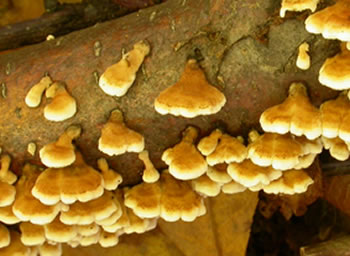
Figure 2. The
undulating margin of the zoned cap is a
distinctive feature. Photo © Gary Emberger.
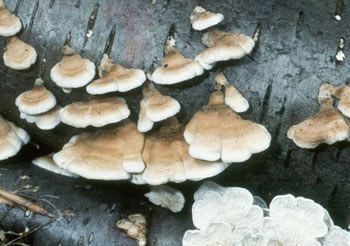
Figure 3.
Figure 3. Top and botton views of the crimped
gill. Photo ©
William Roody.
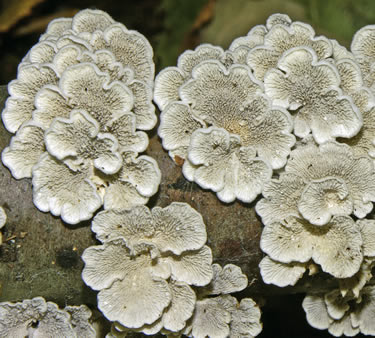
Figure 4. The underside of the caps
reveals the
unusual
structure of the spore-bearing surface. There are no true
gills, or pores, or teeth. Photo © Dianna
Smith.
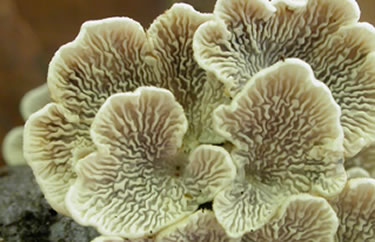
Figure 5. The whitish, spore-bearing surface of
Plicaturopsis crispa is described as gill-like
or having
vein-like folds or wrinkles which may be forked.
Photo © Gary Emberger.
.jpg)
Figure
6. A number of caps have fused together forming an
extensive fertile surface of
wavy, gill-like folds and wrinkles.
Photo © Cheryl Dawson.