Gloeophyllum sepiarium
Scientific name: Gloeophyllum sepiarium (Wulfen) P. Karst.
Derivation of name: Gloeophyllum means "with glutinous or
sticky leaves"; sepiarium means "dark, sepia-colored."
Synonymy: Lenzites saepiaria (Wulf. ex Fries) Fries;
Daedalea sepiaria Fr.
Common names: Yellow-red gill polypore.
Phylum: Basidiomycota
Order: Polyporales
Family: Gloeophyllaceae
Occurrence on wood substrate: Saprobic; solitary or grouped
or in rosette-like clusters most often on dead conifer wood; June
through November, overwinters.
Dimensions: Caps 2.5-10 cm wide.
Upper surface: Bright yellowish-red to reddish-brown or
brown with a white to yellow to orange growing margin; hairy to
almost
smooth; zonate.
Pore surface: Golden-brown; mostly gill-like with few pores;
gills 1.5-2 per mm.
Edibility: Inedible.
Comments: G. trabeum is a similar species but its pore
surface
is more a mixture of gills, pores, and maze-like areas. Its
gills are more crowded (2-4 per mm), its pores are smaller (up
to 4 per mm along the margin), it usually grows on deciduous
wood, and it never has the bright colored growing margin that G.
sepiarium has.
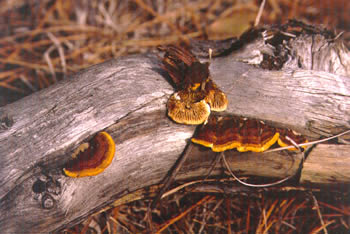
Figure 1. Note the brownish color with bright yellowish
growing margin. Photo © Larry Grand.
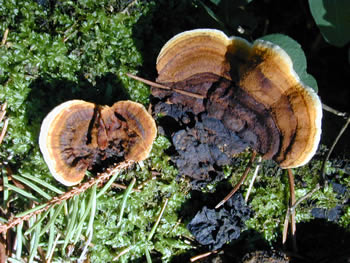
Figure 2. A whitish growing margin and zonate caps. Photo
© Tom Volk.
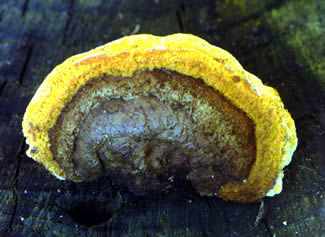
Figure 3. Specimen with a very dark central area and
bright yellow growing margin. Photo © John Plischke III.
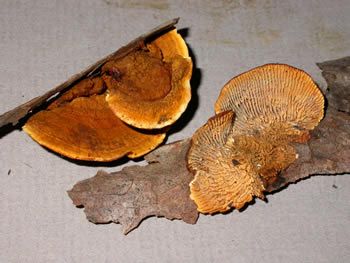
Figure 4.
Herbarium specimens. Photo
© Gary Emberger.
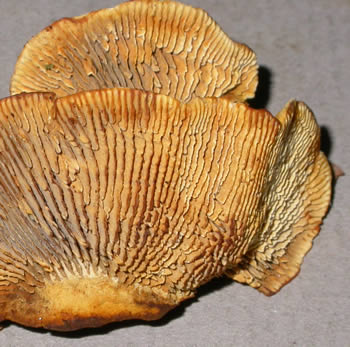
Figure 5. The gill-like pore surface of this herbarium
specimen of yellow-red gill
polypore is entirely gilled
(lamellate) with no pores or maze-like areas.
Photo
© Gary Emberger.
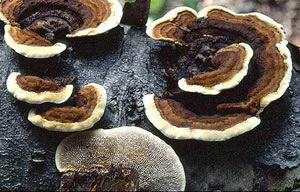
Figure 6. Gloeophyllum sepiarium.
Photo © George Barron.