Mutinus caninus
Scientific name: Mutinus caninus (Huds.) Fr.
Derivation of name: Mutinus was a Roman phallic
deity and
means "penis," cani- means "dog."
Synonyms: Phallus caninus Huds.
Common name(s): Dog stinkhorn.
Phylum: Basidiomycota
Order: Phallales
Family: Phallaceae
Occurrence on wood substrate: Saprobic; solitary or
grouped on
soil, mulch, wood chips, and decaying wood;
August through
October.
Dimensions: Fruit body 7-12 cm tall and 1-2 cm wide.
Description:
Fruit body at first a white to pinkish egg-like
stage,
resembling a puffball. The "egg" is attached to the
substrate by white
mycelial strands (rhizomorphs).
The outer
wall (peridium) of the "egg"
splits and a hollow,
spongy,
stalk expands. The stalk may be whitish below and orangish
to orange-red towards the tip or uniformly white or
uniformly colored. The stalk is
more or less the same
thickness right up to the slightly swollen apex which quickly
tapers to a point. A slimy, olive-brown, fetid spore mass
covers the
upper 1/4 or less (2-3 cm) of the fruit body.
Comments: Flies are attracted to the fetid slimy mass
and serve to
disperse the spores. This species and two
closely
related species - M. elegans and M. ravenelii may
be difficult to cleanly separate from
each other. M. caninus
var. albus, a completely white variety of M. caninus, is
distinctive. M. caninus appears to be the least common of
the three species.
Consult the website below
for additional
comments on these three species.
More information at MushroomExpert.com:
More information at TomVolkFungi.net:
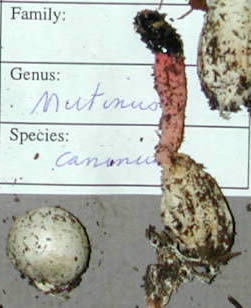
Figure 1. This is a miserable picture of a specimen
from a NEMF foray. Note the small proportion of the
stipe
occupied by the olive-green spore mass.
Photo © Gary Emberger.
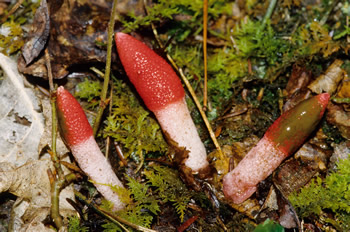
Figure 2. John Plischke III
tentatively identified this
specimen as Mutinus caninus. It could be M. ravenelii.
Photo © John Plischke III.
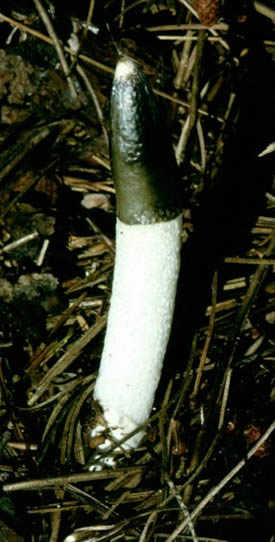
Figure 2. A specimen with an entirely white
stipe.
This is sometimes called Mutinus caninus var.
albus. Photo © Steve Nelsen.
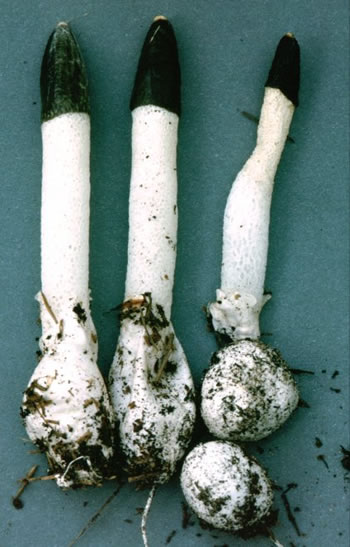
Figure 3. Specimens and "eggs" of Mutinus caninus var.
albus. Only M. caninus has a white variant.
Photo © Steve Nelsen.