Armillaria tabescens
Scientific name: Armillaria tabescens (Scop.) Emel
Derivation of name: Tabescens means "decomposing"
referring the activities of this mushroom.
Synonyms: Armillariella tabescens (Scop.) Singer
Common name(s): Ringless honey mushroom.
Phylum: Basidiomycota
Order: Agaricales
Family: Physalacriaceae
Occurrence on wood substrate: Parasitic/saprophytic; in
cespitose clusters at the base of living or dead trees (often
oak), stumps, or from buried wood or roots; June through
fall.
Dimensions: Caps are 3-10 cm wide; stipes are 5-20 cm
long and 0.4-1.6 cm wide.
Cap: Dry, yellow-brown with darker hairs or tufts of fibers.
Gills: Subdecurrent; whitish, becoming pinkish-brown.
Spore print: White.
Stipe:
White above, darkening to brown near the base.
Veil:
Absent.
Edibility: Choice with caution.
Comments: Sometimes occurs in dense cespitose clusters.
Of the Armillaria species, this is the most distinct due to the
lack of a ring.
More information at MushroomExpert.com:
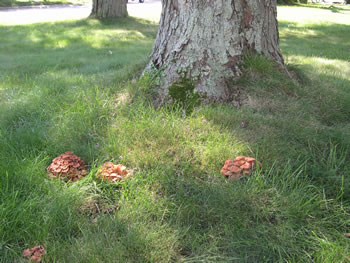
Figure 1. A typical fruiting of Armillaria tabescens. The
specimens in this view are fruiting near a living silver
maple tree, Acer saccharinum.
Photo © Jessica
Stolze-Rybczynski.
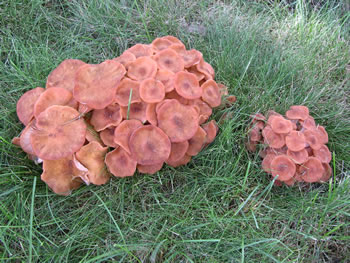
Figure 2.
Although apparently not associated with wood,
these clusters of Armillaria tabescens are undoubtedly
attached to buried wood, most likely the roots of the
silver maple
tree
in Figure 1. Photo © Jessica Stolze-
Rybczynski.
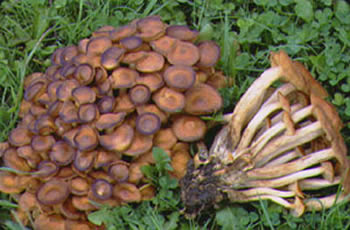
Figure 3. The ringless honey mushroom is aptly named,
the stipe does not have an annulus. Photo © John
Plischke III.
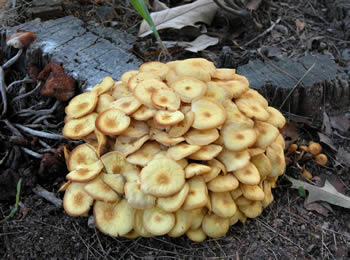
Figure 4. It is quite common for Armillaria tabescens to
grow in dense cespitose clusters. Photo © Larry Grand.
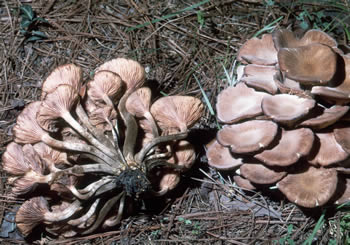
Figure 5. Sometimes when mushrooms are close together
they deposit spores on adjacent caps. The caps on the
right
are whitish with spores and serve as a field spore
print.
Photo © William Roody.
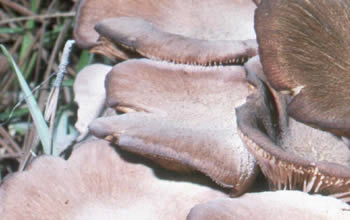
Figure 6. A closeup of some of the mushrooms in Figure
5,
showing the white spore deposit.
Photo © William
Roody.