Hypholoma fasciculare
Scientific name: Hypholoma fasciculare (Huds.)
P.
Kumm.
Derivation of name: Fascicul- means "bundle" referring
to
the clustered or bundled growth habit of this species.
Synonyms: Naematoloma fasciculare (Huds.) P.
Karst.
Common name(s): Sulphur tuft
Phylum: Basidiomycota
Order: Agaricales
Family: Strophariaceae
Occurrence on wood substrate: Saprobic; in clusters
on
deciduous or conifer logs, stumps, or surrounding soil
from
buried wood; May through November.
Dimensions: Caps are 2-8 cm wide; stipes are 5-12 cm
long
and 1.5-10 mm thick.
Cap: Smooth; moist or dry; orange-yellow to sulphur-
yellow
to greenish-yellow.
Gills: Attached; sulphur-yellow to greenish yellow,
becoming
pale purple-brown at maturity.
Spore print: Purple-brown.
Stipe: Yellowish.
Veil: Partial veil leaves a fibrous zone near the stalk apex
which may become purple-brown following deposition of
spores.
Edibility: Poisonous.
Comments: Causes gastric distress.
More information at MushroomExpert.com:
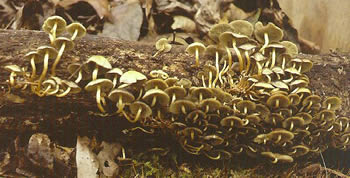
Figure 1. Clusters of sulphur tufts on a log.
Photo © Larry Grand.
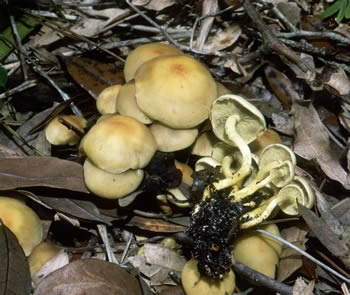
Figure 2.
The gills on these young specimens are still
yellowish. They will become darker as the spores mature.
Photo © William Roody.
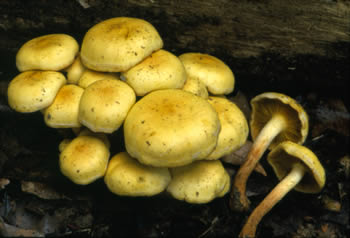
Figure 3. The lower portions of the stipes are typically
darker.
Photo © John Plischke III.