Daedaleopsis confragosa
Scientific name: Daedaleopsis confragosa (Bolton)
J. Schrot.
Derivation of name: Daedaleopsis means "having the
appearance of Daedalea"; confragosa means rough, rugged
and refers to the coarsely wrinkled and bumpy upper surface.
Synonymy: Daedalea confragosa Bolt.:Fr.
Common names: Thin-maze flat polypore.
Phylum: Basidiomycota
Order: Polyporales
Family: Polyporaceae
Occurrence on wood substrate: Saprobic; solitary or
grouped on wood of decaying deciduous trees; June through
December, found year-round.
Dimensions: Caps 2.5-15 cm wide; up to 2 cm thick.
Upper surface: Grayish to brownish; usually zonate with
gray or brown or yellow-brown bands; surface shallowly
grooved (sulcate), radially wrinkled or bumpy.
Pore surface: White to grayish, then
brownish with age;
surface bruises pinkish-brown when fresh; pores develop
into
a maze-like configuration with openings about 0.5-1.5
mm
wide and thin tube walls (usually much less than 1 mm
thick).
Edibility: Inedible.
Comments: Compare to Daedalea quercina which
superficially resembles it and to Daedaleopsis
septentrionalis, which strongly resembles it except that
Daedaleopsis
septentrionalis has a much more
pronounced
lamellate
fertile surface
and is restricted to
birch (Betula spp.)
wood.
See Figure 1
caption.
More information at MushroomExpert.com:
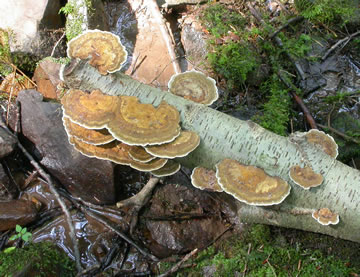
Figure 1. Thin-maze flat polypore on a black birch (Betula
lenta) branch. Daedaleopsis
confragosa grows on birch
wood but care must be taken to examine the fertile surface to
make sure the fungus is not the separate species
Daedaleopsis septentrionalis which grows only on birch and
has a more lamellate pore surface.
Photo © Gary Emberger.
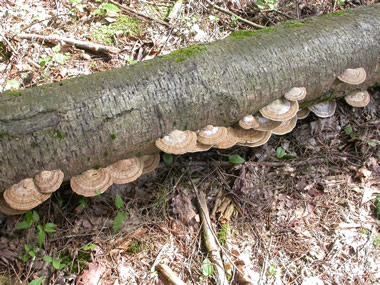
Figure 2. Multiple caps of Daedaleopsis
confragosa.
Photo © Gary Emberger.
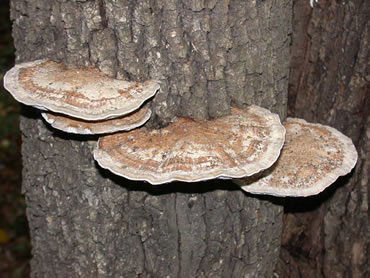
Figure 3. Daedaleopsis confragosa on a standing tree trunk.
Photo © Tom
Volk.
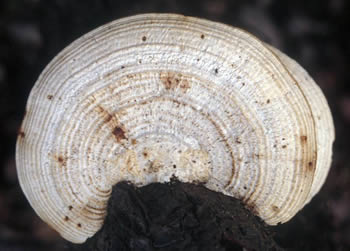
Figure 4. This grayish cap illustrates some of the color
variation present in this species. Note the zonation.
Photo © Gary Emberger.
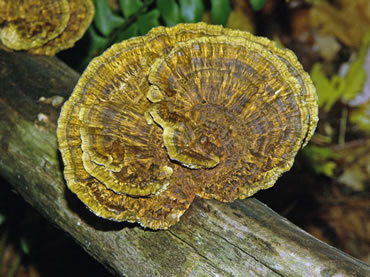
Figure 5. Another variation in the appearance of the caps of
this species. Photo © Dianna Smith.
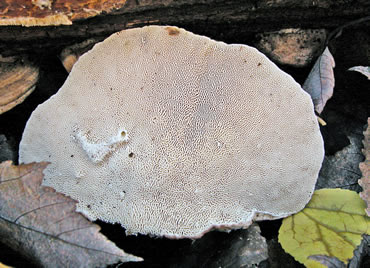
Figure 6. Pore surface of thin-maze flat polypore. Photo ©
Dianna Smith.
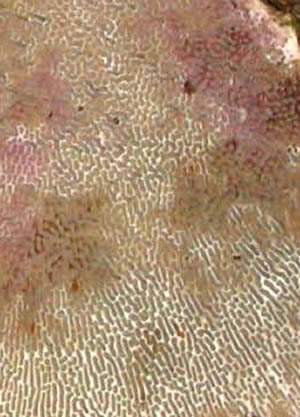
Figure 7. When the
pore surface is young the pores
will bruise pinkish-brown. The pink color eventually
turns
brown. Photo © Gary Emberger.
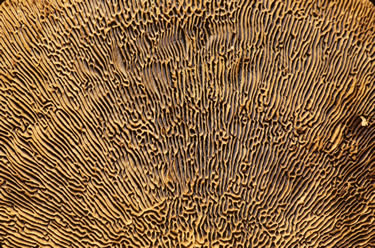
Figure 8. Daedaleopsis confragosa has a beautiful maze-like
pore surface with gill-like areas and other variations as well.
Photo © Noah Siegel.
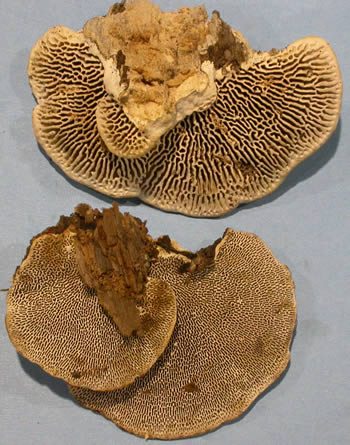
Figure 9. At the top is Daedalea quercina and
at the
bottom is Daedaleopsis confragosa. Although both
have
a daedaloid pore surface, the walls and pore openings
are
much more robust in Daedalea quercina. Photo ©
Gary
Emberger.