Fistulina hepatica
Scientific name: Fistulina hepatica (Schaeff.) With.
Derivation of name: Fistulina means " with small,
hollow
tubes"; hepatica means "liver" in reference to the
similar appearance of this fungus to the liver.
Synonymy:
Common names: Beefsteak polypore; Ox-tongue.
Phylum: Basidiomycota
Order: Agaricales
Family: Fistulinaceae
Occurrence on wood substrate: Saprobic, weakly
parasitic; solitary or in overlapping clusters on deciduous
trunks, stumps, and logs, particularly oak (Quercus); July
through November.
Dimensions: Caps 7-25 cm wide; stalks (if present) 2.5-
7.5 cm long; lateral to eccentric.
Upper surface: Blood-red when young to brownish-red
with age; sticky when moist, finely roughened.
Pore surface: Whitish to yellowish, becoming reddish-
brown in age or with bruising; pores 1-3 per mm.
Edibility: Edible, tart or citrus-like.
Comments: The flesh of this polypore is off-white to
pinkish, with streaks of red. It exudes a red juice. It looks
like a piece of raw meat! Uniquely, the tubes of this
polypore fungus, while closely packed, are free from each
other (use hand lens).
More information at MushroomExpert.com:
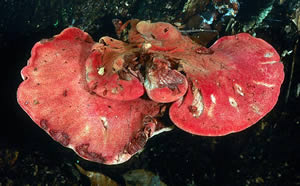
Figure 1. Upper surface of the
beefsteak polypore.
Photo © Pam Kaminski.
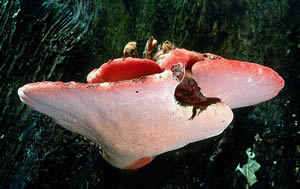
Figure 2. Lower surface of the
beefsteak polypore.
Photo © Pam Kaminki.
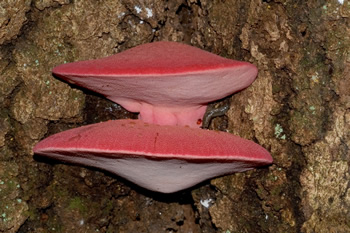
Figure 3. A beautiful fruiting of Fistulina hepatica.
Photo © John Plischke III.
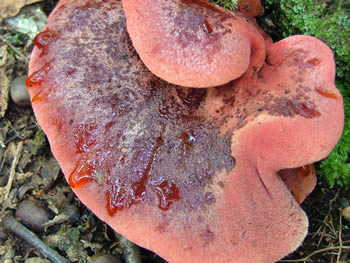
Figure 4. A young specimen with reddish juice oozing out
of the cap. Photo © Gary Emberger.
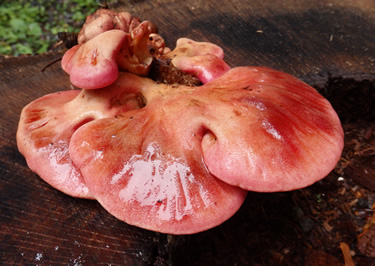
Figure 5. Mature specimen.
Photo © John Dawson.
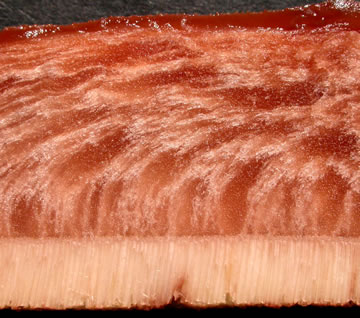
Figure 6.
This section through a mature cap shows a thin
gelatinous top layer, a thick pinkish to reddish meat-like
fleshy layer with paler streaks (resembling marbled meat),
and the layer of tubes at the bottom. Photo © Gary
Emberger.
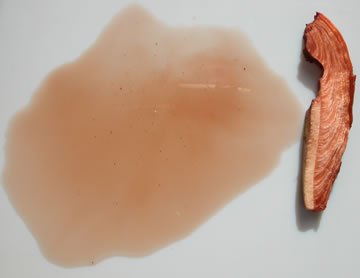
Figure 7.
A reddish juice can be squeezed out of this fleshy
fungus. Photo © Gary Emberger.
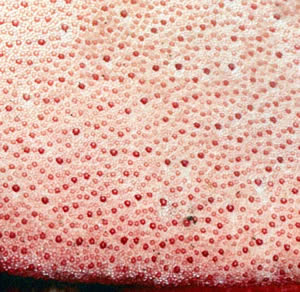
Figure 8. Closeup of pore surface of a young specimen.
Photo © Pam
Kaminski.
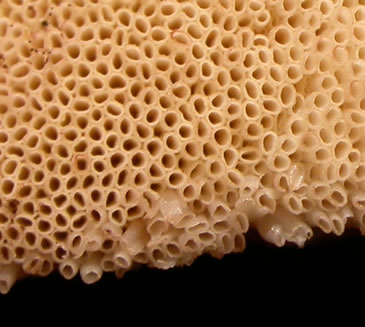
Figure 9. At maturity, the individual tubes of the tube layer
can
be seen. Unlike other polypores, the tubes of Fistulina
hepatica are not
connected to each other. Fistulina means
"with small,
hollow tubes or pipes." Photo © Gary Emberger.