Gloeoporus dichrous
Scientific name: Gloeoporus dichrous (Fr.) Bres.
Derivation of name: Gloeoporus means "a glutinous or
sticky polypore"; dichrous means "two colors" in reference
to the two distinct colors of the cap and pore surface.
Synonymy: Polyporus dichrous Fr.; Caloporus dichrous
(Fr.) Ryv.
Common names: Gelatinous-pored polypore.
Phylum: Basidiomycota
Order: Polyporales
Family: Meruliaceae
Occurrence on wood substrate: Saprobic; often effused-
reflexed, spreading over considerable areas in overlapping
clusters; August through October, overwinters.
Dimensions: Caps 0.5-5 cm wide; up to 10 cm long; up to
5 mm thick.
Upper surface: White; dry; hairy to velvety.
Pore surface: Rubbery-gelatinous, separable; pale reddish
to purplish-brown; pores 4-6 per mm.
Edibility: Inedible.
Comments: A truly distinct feature of this fungus is that the
pore surface is elastic and separable from the underlying cap
tissue. Some people call it the "rubber band fungus" because
of the stretchy pore layer.
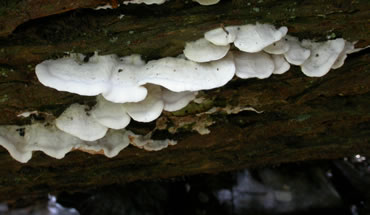
Figure 1. White caps of
Gloeoporus dichrous growing
on a
log just above water. Photo © Gary Emberger.
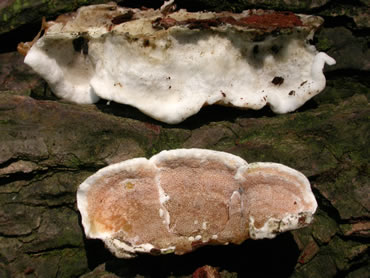
Figure 2. Top and bottom surfaces of specimens of Figure 1.
Photo © Gary Emberger.
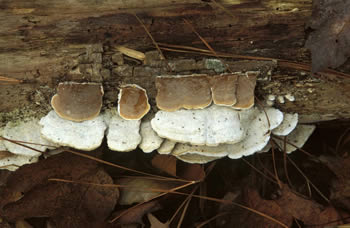
Figure 3. The pore surfaces of these specimens is more
purplish-brown than the pale reddish color of some
specimens. Photo © Larry Grand.
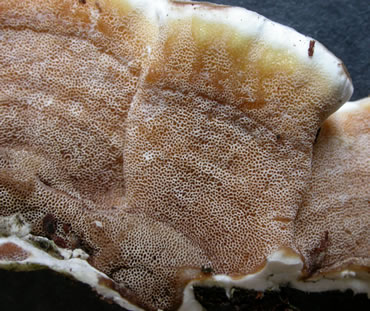
Figure 4. The pore surface of Gelatinous-pored polypore.
Photo © Gary Emberger.
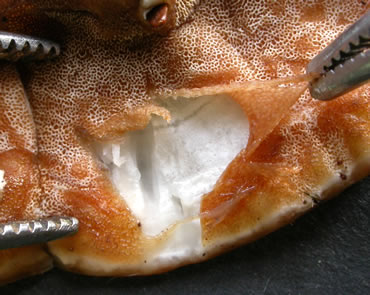
Figure 5. The forceps on the right are pulling the gelatinous
pore layer away from the
cap context. It is very unusual
for a
pore layer to be separable and elastic in this manner.
Photo © Gary Emberger.