Discover MBA Concentrations in Business Analytics and Artificial Intelligence
Discover MBA Concentrations in Business Analytics and Artificial Intelligence
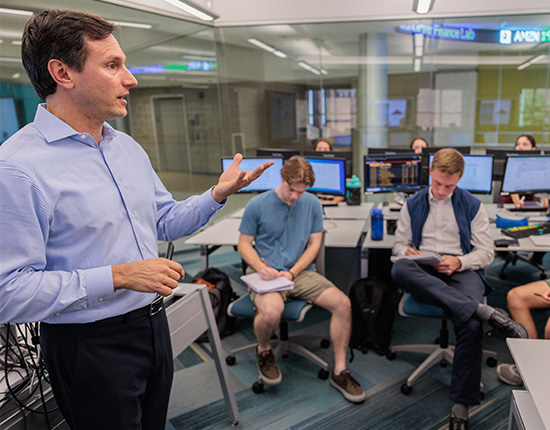 In today’s data-driven economy, leaders who can translate information into insight—and insight into action—are in high demand. For business professionals looking to elevate their careers, an MBA with a concentration in business analytics or artificial intelligence offers a powerful path forward.
These specialized programs at Messiah University combine advanced business education with cutting-edge technical skills, preparing graduates to lead with wisdom, innovation and purpose in a rapidly evolving world. They invite students to see technology as a tool for service, ethical leadership and the greater good—integrating faith, reason and data to make a lasting impact.
We view business analytics and artificial intelligence not just as technical tools but as strategic capabilities,” says Andy Babyak, assistant dean of business at Messiah University. “Business leaders increasingly recognize that fluency in AI and analytics is essential for navigating complexity, driving innovation and leading with insight.
What is an MBA in business analytics?
A concentration in business analytics equips professionals to make data-informed decisions that drive growth, efficiency and innovation. MBA students in this concentration learn to collect, analyze and interpret data using various tools.
Graduates learn how to frame the right questions, translate data into strategy and guide organizations through complex decision-making processes. A business analytics degree is valuable to nearly every industry—from healthcare and finance to marketing, supply chain management and technology.
Career paths and jobs in business analytics
The demand for professionals skilled in data analytics continues to grow. According to the U.S. Bureau of Labor Statistics, data-related occupations are among the fastest-growing job sectors. Graduates of an MBA program with a business analytics concentration may pursue roles such as:
- Business intelligence analyst
- Data analyst or data scientist
- Analytics consultant
- Operations or supply chain manager
- Marketing insights manager
These roles require both analytical proficiency and strategic vision—the kind of balanced expertise an MBA at Messiah University delivers. Graduates not only interpret data but also influence the decisions that shape organizations’ futures, often moving into leadership and executive roles. In this way, jobs in business analytics offer a bridge between technical understanding and business leadership.
The average annual salary for an MBA graduate with a focus on business analytics is $85,000, depending on experience, industry and geographic location.
What is an MBA in artificial intelligence?
An MBA with a concentration in artificial intelligence focuses on the strategic use of AI to enhance business performance, automate systems and deliver innovative products and services. They also explore the implications of AI on ethics, workforce dynamics and global commerce.
This concentration is especially valuable for professionals who want to lead digital transformation initiatives or guide organizations in adopting responsible AI practices. Those pursuing a master’s degree in artificial intelligence online at Messiah University can complete coursework while continuing to work full-time, blending flexibility with career advancement.
What can you do with an artificial intelligence degree?
Graduates with an AI-focused MBA are uniquely positioned to step into emerging roles that require leaders who can analyze large datasets, identify patterns and generate predictive insights that support strategic initiatives and improve efficiency across functions like marketing, finance, customer service and supply chain management. Possible careers with an artificial intelligence degree include:
- AI project manager
- Machine learning operations (MLOps) manager
- Product manager for AI-driven solutions
- Business strategy analyst
- Chief innovation officer
These positions require leaders who understand both the technical side of AI and its strategic business applications. The MBA framework ensures students graduate not just as technologists, but as ethical decision-makers capable of leading people, processes and technology with integrity.
The average annual salary for an MBA graduate with a focus on AI is $79,000, depending on experience, industry and geographic location.
Choosing the right MBA concentration
Both concentrations—business analytics and artificial intelligence—offer exciting pathways for career growth. The right choice depends on your goals and interests:
- If you’re drawn to strategic decision-making, optimization and interpreting data to improve business performance, business analytics may be the ideal fit.
- If you’re inspired by emerging technologies, automation and AI-driven transformation, the artificial intelligence concentration may align more closely with your ambitions.
Either way, pursuing a specialized MBA degree can position you for long-term success in the evolving global marketplace.
An MBA with a concentration in business analytics or artificial intelligence offers more than career advancement; it’s an invitation to lead with integrity, grounded in both data and discernment. At Messiah University, you’ll gain not only advanced analytical and technical skills but also a sense of calling to use them wisely in service to others.
Lead with insight and purpose
In a world increasingly shaped by algorithms and automation, it’s vital to ground innovation in strong ethical principles.
Messiah University offers a distinctive approach to graduate education in artificial intelligence and business analytics by integrating cutting-edge business practices with a foundation in Christian values,” says Babyak. “This combination equips students not only with technical expertise but also with the ethical framework needed to lead responsibly in today’s data-driven economy.
Messiah University provides the opportunity to examine questions of purpose and morality alongside data and machine learning models. This approach ensures that success is not only measured by profit or efficiency but by impact and integrity.