From Grantham to Rome: Messiah faculty advance manual therapy on a global stage
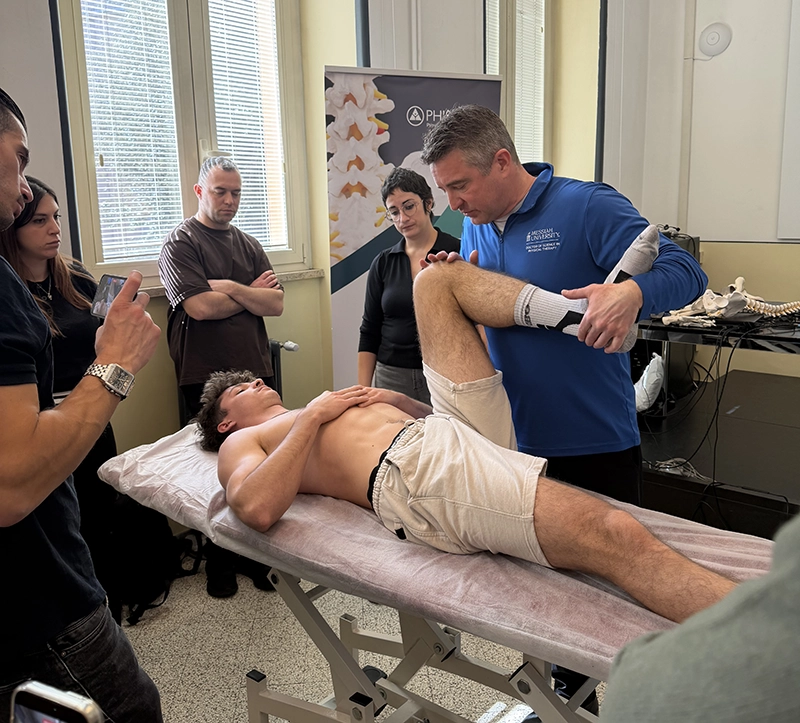
Messiah University’s Doctor of Physical Therapy program is gaining international recognition as faculty bring their expertise beyond campus and into global clinical communities. Most recently, Michael Lehr, DSc, DPT, OCS, COMT, FAAOMPT, associate professor in Messiah’s Doctor of Physical Therapy program, was invited to teach advanced manual therapy courses in Rome, Italy—an opportunity that reflects both individual faculty excellence and the growing reach of Messiah’s continuing education programs.
Lehr led Italian clinicians through components of the Certified Orthopedic Manual Therapist (COMT) curriculum, focusing on clinical decision-making, movement assessment and advanced treatment of lower extremity conditions. The invitation itself signals a broader trend: Messiah’s faculty are not only educating future physical therapists in central Pennsylvania, but also shaping post-professional practice worldwide.
The demand for evidence-based, hands-on orthopedic training is global,” said Lehr. “What we teach at Messiah translates across borders because it is grounded in strong clinical reasoning and current research.
That global impact is strengthened by the collaborative culture within Messiah’s DPT program—one that extends into its continuing education offerings. A notable example is the connection between Lehr and fellow faculty member Borko Rodic, PT, DPT, DSc, FAAOMPT. Years ago, Lehr served as Rodic’s residency mentor. Today, both are advancing manual therapy education in complementary ways: Rodic teaches similar coursework at Messiah, regularly drawing practicing clinicians, alumni and current students into the learning environment.
This full-circle dynamic highlights a distinctive strength of Messiah’s program—faculty who not only mentor the next generation but continue to collaborate as colleagues, expanding the program’s influence both locally and internationally.
Through these continuing education courses, Messiah creates a unique intersection where classroom learning, clinical expertise and professional development converge. Students benefit from faculty who are actively engaged in scholarship and practice, while alumni and regional clinicians remain connected to cutting-edge techniques and research.
Lehr’s work in Rome also underscores the integration of scholarship and teaching that defines Messiah’s faculty. By incorporating findings from his own research into course instruction, he brings real-time evidence into hands-on clinical training. This emphasis on research-informed practice is a hallmark of the DPT program and a key reason its faculty are sought after on the international stage.
Ultimately, these global teaching opportunities reflect more than individual achievement—they point to a program committed to excellence, service and influence. Whether in Grantham or Rome, Messiah faculty are equipping clinicians with the skills and reasoning needed to improve patient care.
As Messiah’s DPT and continuing education programs continue to grow, so too does their reach, demonstrating that the work happening in one classroom can have an impact far beyond it.