Taste & See
Five Stories and Recipes from a New Messiah Cookbook to Inspire your Next Meal
Eating together can reveal something holy—love and grace made visible. When we gather to share a meal, we come as imperfect people carrying the weights of life. We are welcomed just as we are. Around the table, belonging becomes real, stories are shared and connections strengthened. We leave the meal nourished, with bellies full and spirits renewed for the work ahead.
Food brings us together—with those we know but also with those we might least expect. In Luke 14, Jesus says to welcome the stranger, the poor and the outcast. Jesus’ table is open to anyone who is willing to come. The Greek word for hospitality in the New Testament, philoxenia (φιλοξενία), is translated as the “love of strangers.” Jesus’ approach to hospitality is radically inclusive.
At Messiah, we’re committed to following Christ in practicing profoundly open hospitality to loved ones and strangers alike. And it was this concept that offered shape and vision this past spring as I compiled “Gather Around the Table,” a new Messiah community cookbook.
The initial idea came from the 2026 Humanities Symposium held on campus that focused on the topic of food and culture. It seemed fitting for the library, a hub of community life, to coordinate such a project. In fact, we already house quite a few community cookbooks in the University archives, the oldest dating back to the 1950s.
“Gather Around the Table” adds another chapter to a long, warm tradition at Messiah of not only breaking bread together, but also sharing the recipes we use to make our daily bread.
Cookbooks are cultural documents as much as they are practical guides. With just over 100 recipes—offered by students, employees, trustees and alumni, along with a few favorites from Lottie Nelson Dining Hall—this new edition creates a vibrant snapshot of the Messiah University community of 2026.
The food we eat tells a story, expressing our identity, heritage, habits and traditions. It sustains our bodies even as it adds zest and flavor to our daily lives.
The recipes included on following pages offer a taste of the extended Messiah community—and invite us to consider how we might generously and open-heartedly pull up a chair for guests, family, neighbors, friends and strangers to join the feast.
May good food and good conversation bless your table and nourish your soul.
—Sarah K. Myers, public services librarian at Murray Library
Banana Bread with Chocolate Chips
Browned bananas’ time to shine
Ingredients
- ½ cup sugar
- 1¾ cups flour
- ½ tsp. salt
- ½ tsp. baking soda
- 1 Tbsp. baking powder
- 1 cup mashed ripe bananas (about two or three bananas)
- ⅓ cup vegetable oil
- ½ cup water
- ½ cup chocolate chips
Instructions
In a large bowl, combine sugar, flour, salt, baking soda and baking powder.
In a smaller bowl, mix together mashed ripe bananas, vegetable oil, water and chocolate chips.
Add the contents of the smaller bowl to the mixture in the large bowl and stir to combine.
Place mixture in a greased loaf pan. (I like to use a 9” stone loaf pan.) Bake at 325°F for at least an hour, probably more, but test with a toothpick for doneness.
Story behind the recipe
I got this recipe from my grandmother. It’s unique because it requires no eggs, making it easier to use while at school without consistent access to fresh ingredients. (Besides the bananas, every other ingredient is nonperishable.)
The story starts with how I came into a large sum of pre-peeled bananas. A Lottie worker was peeling over-ripe bananas to prepare them for composting. I noticed what he was doing and asked if I could have them because they would be perfect for banana bread. I got permission from the manager to take them, as long as I could find a way to get them out of Lottie. So, I acquired some brown paper bags and loaded them up with peeled bananas.
When I got back to my dorm, I knew what I needed to do: It was time to whip out this trusted recipe. I had about 30 bananas to work with, so I got busy and made two loaves and 24 muffins. I genuinely surprised everyone when I brought some back to Lottie as a thank-you because they didn’t think I was actually going to do it, let alone by dinner time. I was encouraged to share this delicious recipe after converting several banana bread haters with its amazingly moist and balanced texture and taste.
—Madison Hause ’29
Cheesy Chicken Wild Rice Soup
Warm memories of loved ones
Ingredients
- 1 package (6 oz.) wild rice mix
- 4 cups milk
- 1 medium carrot, shredded
- 2 tsp. minced onion
- 1 can (15 oz.) cream of chicken soup
- 4 oz. cheddar cheese, grated
- 4 oz. cream cheese, cubed
- 1–2 cups cooked chicken, shredded
Instructions
In large saucepan, prepare rice mix according to package directions. Stir in milk, carrots, onion, soup, cheeses and chicken. Cook and stir until both cheeses are melted and carrots are tender. Makes 6–8 servings.
Story behind the recipe
This recipe comes from a Lancaster County farm recipe book. My late husband’s vocation was agribusiness. We were gifted this book, and in the last few years of his life, he enjoyed making soup and delivering it to his sisters. This was one that he turned to again and again. He always tweaked the recipe, cooking onions and carrots in some butter to soften and adding extra cheese. I’m including these adjustments because this soup not only nourishes physically, but it was a gift of love my husband gave from his heart. I’ve made it a few times since he died, but it has never tasted quite as good. He had a special touch!
In addition to the soup, he’d make applesauce with the grandchildren and deliver it to family and friends. We have continued the tradition after his death, making it around his December 16 birthday. It’s bittersweet but becoming a beloved way to remember an awesome man and grandpa.
—K. Doneen Ruhl Dourte ‘79, member of the Board of Trustees
Chakalaka
South African classic
Ingredients
- Cooking oil
- 1 onion, finely chopped
- 2 chilies, finely chopped
- 2 tsp. garlic, minced
- 1 tsp. ginger, grated
- 2 Tbsp. mild curry powder
- ½ green, red or yellow pepper, diced
- 4 carrots, grated
- 1 tomato, grated
- 1 tsp. sugar
- 1 can (15 oz.) baked beans (like KOO brand)
- Salt and pepper to taste
Instructions
Heat oil in a pan and cook onions until soft and translucent. Add chilies, ginger, garlic and curry powder; stir to combine. Add the peppers; cook for another 2 minutes. Add the carrots and stir to coat in the curry. Cook on low heat until carrots are tender. Add the tomatoes and sugar. Season with salt and pepper. Cook for 10 minutes to thicken.
Remove from heat and stir in the baked beans. Serve hot or cold.
—Ester Moyo ’26
Pork Belly Kor 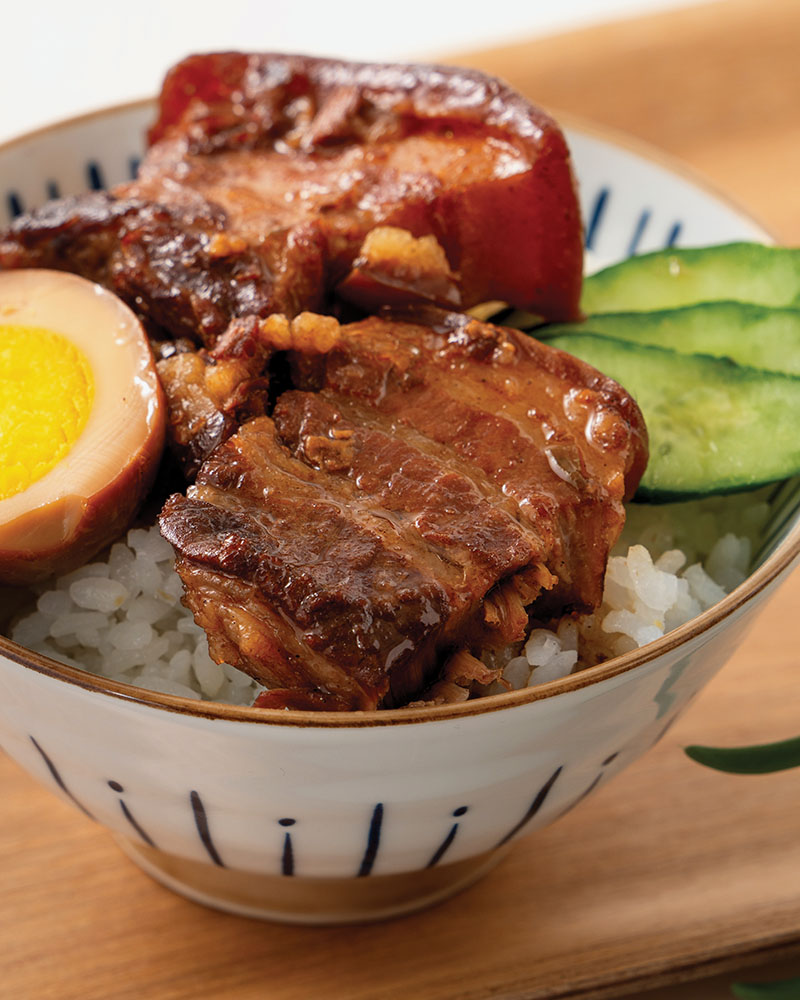
Umami that tastes like home
Ingredients
- Pork belly or pork loin (we often use both)
- Hard-boiled eggs, peeled
- Bamboo shoots, sliced (optional)
- Palm sugar (or regular granulated sugar)
- Fresh ginger, sliced thinly
- Garlic, minced
- Oyster sauce
- Fish sauce (optional)
- Ground black pepper
- MSG (optional)
- Chicken powder
- Salt
- Jasmine rice, cooked
- Optional toppings: peeled and sliced mango, sliced scallions, diced cucumbers
Instructions
Cube pork. Marinate pork with salt, MSG, oyster sauce and chicken powder for 15 minutes. (If you don’t want to or can’t use pork, you may use fish.)
In saucepan, over low-medium heat, add palm sugar and stir until sugar browns/ caramelizes.
Switch to low heat and add garlic, a little more chicken powder and fish sauce. Stir.
Add pork and increase to medium heat. Stir until the meat sweats out (liquid/oil comes out of the pork) for at least 10 minutes. (Simmering longer will make the meat more tender.)
Add black pepper and water, and let simmer on medium heat for approximately 30 minutes. Add bamboo shoots, ginger and hardboiled eggs, and let simmer on low. Adjust seasonings to taste and moisture level to preference. (I prefer my Kor to be just liquid enough that it will coat my rice for added flavor.) Serve over cooked rice.
Story behind the recipe
These days, while my motherland of Cambodia is under attack again, I feel extremely lucky to be sheltered and secure, while my people experience more displacement and instability. I don’t take any of it lightly.
My ម៉ាក់យាយ (grandma) passed away in November of 2025 after surviving the Civil War in the 1960s and the Khmer Rouge Genocide in the 1970s. She was the matriarch, always finding a way to feed the whole community through meals cooked in pots filled to the brim over her clay bucket stove.
Legend has it that my grandma carried my ម៉ាក់ (mom), who was barely three years old when Pol Pot invaded Phnom Penh, around her waist all the time. I guess that’s how my mom picked up the skill of cooking such unfalteringly scrumptious meals that you can smell in your sleep. Seriously, I think my nostrils are adapted to this melty mouthwatering umami goodness that seems to replace every bad day with a full stomach and a deep urge to rest. This must be the smell of the good life, despite it all.
Kor is a family favorite—maybe for many or all Cambodians everywhere. Served on top of Jasmine rice, Kor is the flavor of home returning to our bloodstreams. May we always find a way home.
—Phalika Oum ’23
Shoo-Fly Pie
Pennsylvania Dutch sweet treat
Ingredients
- 1 cup flour
- ½ cup brown sugar
- 1 Tbsp. shortening
- ⅓ cup mild Brer Rabbit Molasses
- ⅔ cup King Syrup
- 1 egg, slightly beaten
- 1 tsp. baking soda
- ¾ cup plus ¼ cup hot water
- 1 unbaked pie shell
Instructions
In a bowl, mix the flour, brown sugar and shortening until crumbly. Take out and save ½ cup for topping.
To the remaining crumbs, add the mild Brer Rabbit Molasses, King Syrup, slightly beaten egg and ¾ cup hot water. Mix well.
Separately, mix baking soda with ¼ cup hot water, then add to the crumb mixture.
Pour into an unbaked pie shell. Top with the reserved crumbs. Bake at 350°F for 40–45 minutes.
Story behind the recipe
Shoo-fly pie has become a cherished yearly treat in the Murray Library, thanks to David Weaver-Zercher ’83, professor of American religious history. When Dr. Weaver-Zercher teaches his first-year seminar, Old Order Amish and Us, he makes this pie for students to try, using a recipe he got from friends at Slate Hill Mennonite Church, Ron and Rhoda Hershey. If there are any leftovers, he brings them to share with our team. This version is the classic wet-bottom style, with its layer of gooey molasses goodness tucked beneath a crumbly top. It’s especially perfect in the morning with a cup of coffee and has even made an appearance at our library’s Monday coffee break. It’s a sweet reminder of community and the simple joy of gathering together.
—Murray Library, with David Weaver-Zercher ’83
Get the cookbook
Download a free PDF of all 100+ recipes—including some Lottie Nelson favorites!—featured in “Gather Around the Table.” Print copies can be purchased for $10 (plus shipping) by emailing library@messiah.edu.