All Things Visible and Invisible
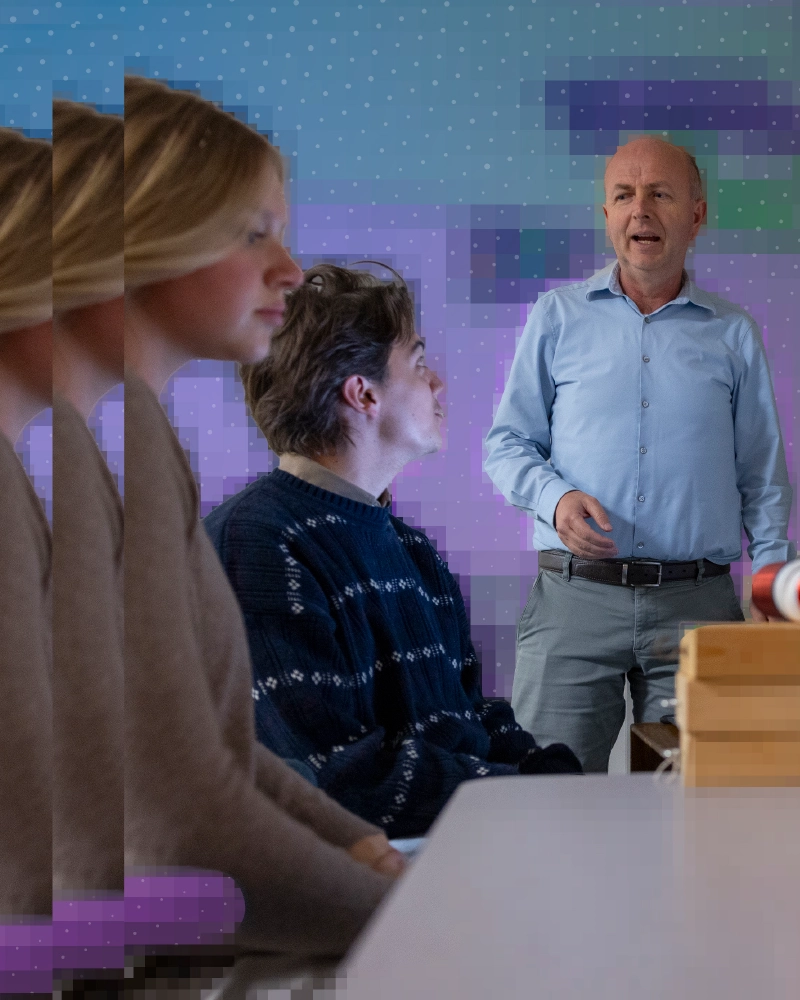
With a prestigious grant, a physicist and his students are delving into the mystery of dark matter
By Matthew G. Solovey
“We believe in one God, the Father almighty, maker of heaven and earth, of all things visible and invisible.”
When writing the opening lines of the Nicene Creed, the authors likely didn’t imagine molecules, atoms or quantum particles. But it’s curious that in a statement created to clarify faith, they begin with mystery — the truth that reality extends far beyond what the eye can see.
At Messiah University, Professor of Physics Abaz Kryemadhi has a unique perspective on that mystery. “Imagine trying to read a book when five out of every six pages are missing,” Kryemadhi says. “That’s where physics stands today. We’ve learned a lot, but most of the ‘pages’ are still blank.” His work centers on the missing chapters of our universe, including one of the most elusive: dark matter. “Discovering dark matter wouldn’t just change our view of the cosmos, it could reshape our understanding of the laws of nature themselves,” Kryemadhi says.
Seeing the mystery
Dark matter is the invisible substance thought to make up about 85% of the universe’s mass. While scientists can’t see it, they can see its effects. “People may think dark matter is like a mysterious fog or black dust floating through space or even some rare material on Earth,” Kryemadhi says. “But it’s most likely made of tiny particles that don’t interact with light the way ordinary matter does. It’s called ‘dark’ only because it’s invisible to our instruments.”
To understand dark matter, think of the universe as a vast stage. The stars, planets and galaxies are the actors under the spotlight — what we can see and measure. But what truly holds the stage together is the unseen structure beneath it: the beams and scaffolding that give everything its form and stability. That hidden framework is like dark matter. “We can’t see it directly, but we know it’s there because of how galaxies rotate and how light bends when passing near massive objects,” Kryemadhi says. “Without dark matter, the galaxies and cosmic structures we see wouldn’t hold together. It also counteracts, through gravity, the expansive pull of dark energy that would otherwise tear the universe apart.”
For Kryemadhi, looking up at the night sky nurtured the curiosity of what was holding it all together. “Growing up in rural Albania, we had no light pollution, so the Milky Way covered the sky in crystal-clear detail,” he says. “I remember wondering, What holds all of this together? Why does it look so ordered?” Physics helps explain it. “It doesn’t just describe what happens —it asks why,” he says. “For me, studying physics felt like opening the book of nature itself, where every equation is a line of text revealing how creation works. It’s more than solving problems; it’s about uncovering the hidden logic that makes the universe possible.”
Now, new funding will further Kryemadhi’s work — and make Messiah a contributor to two global experiments searching for that hidden logic.
Access granted
In 2025, the National Science Foundation (NSF) awarded a grant to support Kryemadhi in his research and in providing students with hands-on learning opportunities. The designation marks Messiah’s first NSF research grant in more than 40 years. Kryemadhi’s project will enable him and a student team to set up a station equipped with highly sensitive sensors to detect extremely faint signals from the far reaches of the universe, signals that could come from dark matter or other yet undiscovered physics phenomena. The NSF-funded work connects Messiah to two international collaborations: the Global Network of Optical Magnetometers for Exotic Physics Searches (GNOME) and the Search for Non-Interacting Particles Experimental Hunt (SNIPE Hunt). GNOME links together extremely sensitive detectors around the world that “listen” for faint magnetic pulses. If several pick up the same signal at the same moment, it could mean something extraordinary — like a ripple of dark matter passing through Earth. SNIPE Hunt takes an even broader approach: It uses the Earth itself as an antenna, searching for tiny magnetic waves that might reveal the presence of dark matter all around us.
Messiah’s station will join others around the world in what Kryemadhi calls “a global listening experiment.” “A discovery made here in Mechanicsburg could directly align with one thousands of miles away,” he says. “Our students and faculty aren’t working in isolation; they’re part of a global scientific effort.”
A learning experience
Students will be involved in every part of the project. They’ll assist with building and maintaining the sensors, collecting and analyzing data using time-series analysis and machine learning, comparing results with international collaborators and co-authoring papers and presenting at conferences.
“This isn’t just laboratory work,” Kryemadhi says, “it’s hands-on training for the next generation of physicists, working on real-world, cutting-edge research.” The two students who will work on the project this summer are Franklin Kelly ’27 and Zoë Prettyman ’27. Kelly, a junior physics major with a philosophy minor, approaches the mystery with enthusiasm and a bit of philosophical humor. “To be honest, all physics is mysterious,” he says. “The deeper you go, the stranger it gets. You realize that to make sense of it all, you have to ground yourself in something eternal. Physics can describe how matter behaves, but it can’t explain being itself. Ultimately, you must ground yourself in something reliable and eternal, something with pure inherent being.”
Kelly says working closely with Kryemadhi has been a highlight. “After class, during his office hours, or hiking back and forth from the experiment, I’ll pick his brain on all things physics,” Kelly says. “He is always enthused to discuss, help make connections, and support us as growing physicists.” Prettyman, a senior physics major with a minor in electrical engineering, says her background in circuits will come in handy. “We’ll be constructing technology for the experiments and implementing it in data collection,” she says. “I’m excited to get hands-on experience with real research —something usually reserved for graduate students.” She sees in the project a reflection of faith itself. “Hebrews 11:1 says, ‘Now faith is the substance of things hoped for, the evidence of things not seen,’” reflects Prettyman. “We can’t physically see God or the Holy Spirit, but we know that both are constantly with us because of how we can be influenced or moved by the Spirit.”
The bigger picture
Kryemadhi sees a similar connection. “My faith reminds me that studying the laws of physics means uncovering the order and beauty God built into creation,” he says. “The theologian and physicist John Polkinghorne called science and faith ‘a binocular vision’: two perspectives that, together, give a clearer picture of reality.” Early Christian thinker Cyril of Jerusalem (313–386 A.D.) observed that everything done in the world, even by those who are unconnected with the church, is done by faith. Farmers, for example, work in faith. They plant seeds, tend the soil and trust that the harvest will come, even though they can’t see it yet. “I see mystery not as failure, but as invitation,” Kryemadhi says. “Mystery is where both science and faith come alive. In physics, mystery drives us to keep exploring; in faith, mystery draws us deeper into trust and worship, even when we don’t have all the answers.” It alludes to humanity’s place in the universe.
“It teaches humility,” he says. “We’re small, living on a tiny planet in a vast cosmos and yet it also teaches dignity. We’ve been given minds capable of asking questions about the structure of the universe itself. That balance of smallness and significance is profoundly human. “Sometimes I’m asked, ‘If you don’t find dark matter, are your efforts wasted?’ My answer is no; discovery is a journey. The pursuit itself matters. Just like in faith, not having all the answers doesn’t mean we stop asking the questions.”