Our Alumni
Dwelling in the Gaps
 Seven experts reflect on the experience of venturing into unfamiliar territory —and share tools they’ve found grounding
Written and curated by Kimberly Forry ’00
Artwork by Emily Fussner
Artwork by Emily Fussner
“For now we see only a reflection as in a mirror; then we shall see face to face. Now I know in part; then I shall know fully, even as I am fully known.”
1 Corinthians 13:12
Despite hours of training and years of practice as a hospice volunteer, I enter each vigil assignment with little to no idea of what I’ll encounter. On this particular morning, I head from the elevators in the inpatient hospice unit to a spacious, sun-drenched room at the end of the hall. My phone carries the few notes I received ahead of time from my supervisor: the name of the patient, his age, terminal diagnosis, family members, career and a few hobbies or interests. I have no idea if I’ll arrive to find Mark* alert or comatose, comfortable or agitated. I don’t know how I’ll fill my two-hour shift; I may sing, read, pray or simply sit quietly by Mark’s bedside and hold his hand. Ultimately, I don’t even know if Mark will live through my shift.
Yet while the unknowns outweigh any information or certainties I possess, I approach each situation with a sense of expectation, confident that God is at work in ways I cannot predict or control. Sitting with death has taught me about both the sovereignty and mystery of God.
Yet while the unknowns outweigh any information or certainties I possess, I approach each situation with a sense of expectation, confident that God is at work in ways I cannot predict or control. Sitting with death has taught me about both the sovereignty and mystery of God.
How do we find our way between the known and unknown, the seen and unseen, the illusion of control and our utter lack of it?
Following are several perspectives from Messiah University’s community of educators on how they encounter and navigate the unknown in their respective fields. As I’ve discovered in my work in hospice, there’s much we don’t know — but much can be revealed as God’s people come together to share and to listen.
—Kimberly Forry ’00, hospice volunteer and author of “Thin Spaces” (On Knowing Humanity Journal, January 2025)
* a pseudonym
Examining loss
The first place I worked as a counselor was in the short-stay inpatient psychiatric unit of a hospital. That sounds very serious but it was a really lovely place to care for my fellow humans, who’d usually experienced a very difficult moment in their lives prior to being admitted — an overdose, a traumatic loss, an attempt to end their life or a mental health crisis.
Beyond supporting patients directly, one of my roles was meeting with patients’ families prior to discharge. In those conversations, we’d acknowledge progress, but what hung in the air was the longer road of healing ahead. Often, while patients were riding high on a fresh beginning, families were more clear eyed about what could happen when the wave crashed, even as they expressed their deep love and care. Some had been through this scenario many times.
Later, when I counseled families on the other side of that intense time, I found a name for what they were experiencing: ambiguous loss. We’re all familiar with the loss that comes in the wake of a death, but when a loved one has dementia or an addiction or is estranged, grief can go unrecognized. Still, these situations contain loss — one with no clear endpoint or resolution.
I help my clients experiencing ambiguous loss to focus on three things: acknowledging their grief, allowing themselves to survive and thrive and figuring out how to hope. Families learn quickly that placing all their hope on one specific outcome, event or treatment leads to disappointment. Instead, we look to things that endure — the love they have, the care they’ve already poured out and, for those who believe, the faith they have in a sovereign God who can see the path we cannot.
—Leah Clarke, professor and director of Messiah’s graduate program in counseling
Training for the next step
Every moment of our existence, we’re living on the edge of the unknown. As time passes from one moment to the next, future becomes present. Mystery becomes reality.
In our daily lives, we can approach each moment like an athlete. Athletes lean into the uncertainty of the next moment as they pursue excellence. They plan for future performance, train for future accomplishments and run head-on into the unknown.
Each maximum effort is an opportunity with equal potential for greatness and catastrophe. When the human body is pushed to perform at its best, the results are often as devastating and painful as they are record-breaking and memorable. When success is achieved, it fuels the pursuit of the next goal. When injury occurs, the lessons of an athlete’s preparation sustain them through the unknown of recovery and allow them to press on with courage.
Each day, we can replace fear of the unknown with excitement about the possibility. Striving is our accomplishment. Willingness to prepare, work and accept the unknown is the victory. If we already knew the outcome of the next moment, we’d be subject to that outcome. The unknown is what allows us to set our sights high and work toward unthinkable goals.
—Matthew Lewis, professor and director of Messiah’s graduate program in athletic training
Welcoming the Wrestling
Once, I asked my students to link arms while standing in a circle to portray how Christians can appear: close-knit, but also cliquish. Then, we repeated the exercise, turning outward this time. It was awkward. Shoulders stretched backward while necks strained forward. Some students found themselves facing a wall. The experience embodied the tension of being joined together for the sake of reaching out. At minimum, discomfort is what faithfulness feels like in a fallen world.
Hebrews 13:1–2 calls Christians not only to philadelphia (sibling love), but also to philoxenia (love of strangers), translated as “hospitality.” As Christ has welcomed us, so we are to welcome others. Lest we mistake hospitality for a unilateral act, Hebrews 13 points to Genesis 18. There, in welcoming three strangers, Abraham and Sarah entertain angels unawares. They give generously to their guests but end up receiving the greater gift: God’s promise of a son.
Years later, Abraham and Sarah’s grandson, Jacob, would have his own mysterious encounter with a stranger (Genesis 32). If his grandparents’ story teaches that the strangers we welcome often bless us beyond what we manage to give, then Jacob’s story shows that the blessing we receive will not leave us unscathed. Engaging strangers requires wrestling, not only with others’ strangeness, but also with our own assumptions. Wrestling requires stretching, straining and discomfort, at minimum. As with Jacob, it may put us out of joint. But if we’re willing to learn from the struggle, then we may end up with a blessing — and find ourselves forever changed in the way we walk in the world.
—Bonnie E. Lin, assistant professor of Christian ministries
Facing the unknown — with love
My husband and I have had the gift of raising two children. Even though I teach and write about parenting in my profession, I’ve encountered many uncertainties in our personal journey as parents. I’ve wondered if we were providing them with the opportunities that would help them succeed, or the boundaries needed for them to develop morals and values necessary to lean into their identity as God’s child. Finding our own purpose is challenging enough but helping our children to discern theirs is daunting.
In moments like these, I’ve often relied on Jack and Judy Balswick’s idea of family theology for guidance. In their view, family relationships revolve around unconditional love. Within the context of unconditional love, we can empower children to develop their gifts themselves and to explore ways to use those gifts to serve God and others. In this model, our job isn’t to control — but to love, as our children do the work of getting to know themselves and God.
And how do we cultivate this love? We get to know our children. We listen to them, observe them and allow for grace or forgiveness when our children (or we ourselves!) fall short.
Sometimes, this approach reminds me to put down the phone (or other distractions) to develop the deep relationships with my children that help love grow — and can make the unknown a little more known.
—Erin Boyd-Soisson, professor of human development and family science
Faithful reminders
I often return to the story of river rocks in the book of Joshua, chapter 4, for encouragement and wisdom. God guides His people into the unknown. Then, He commands them to take smooth river rocks as reminders of how His presence has led and will lead them. New leaders. New land. Same great God.
In the fall of 2019, after much work and waiting, I launched my first business startup, a childcare center in Southern California.
Of course, little did I know that we were headed into an “unprecedented” business environment in 2020.
To my great relief, the startup survived and then thrived. But the breakthrough in my own life was finding out that even if it didn’t, God’s presence would sustain and flourish me. I’ve added that river rock to my collection of ways God has been faithful. What river rocks has God given you?
P.S. I’m writing this reflection while sitting alone in a waiting room — a place of the unknown — as I wait for my 4-year-old to come out of surgery. In my mind, I turn over my smoothed rock again, reminding myself that God’s presence is with me here and now, too.
—Timothy Captain, assistant professor of business
Update: Timothy Captain has given permission to share the good news that the outcome of his son’s surgery was positive.
Formation in the gaps
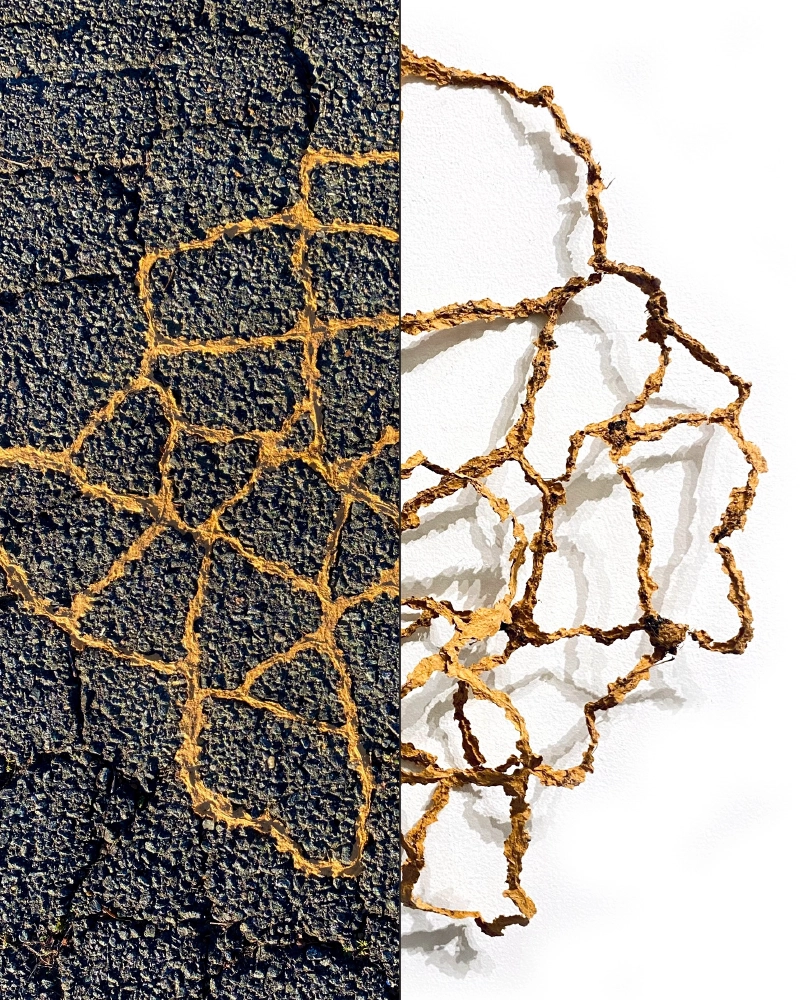
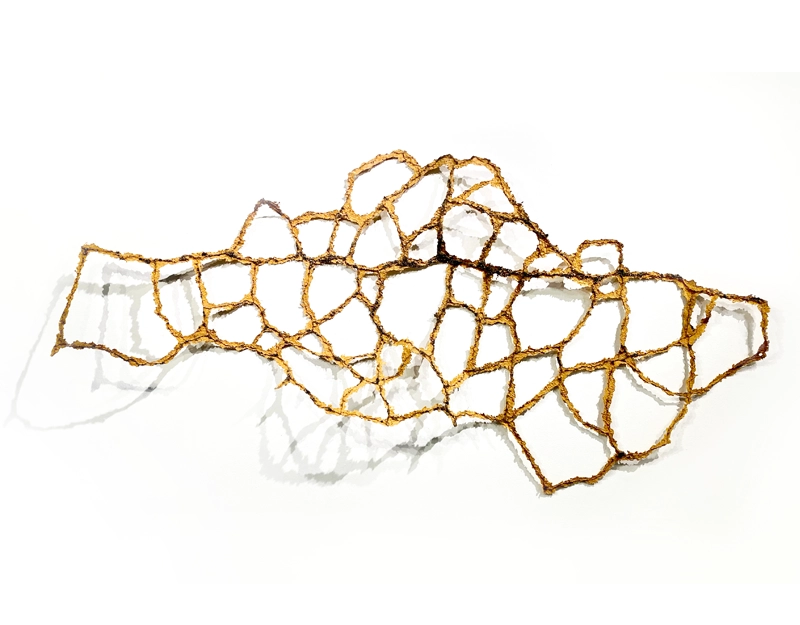
I spend a lot of time crouched down close to cracks and light. In parking lots, I cast cracks with paper pulp; I trace and photograph shifting shapes of sunlight and shadow in stairwells, hallways, alleyways. Considered with attention and care, these overlooked transitional spaces and peripheral patterns become thresholds of poetic possibility.
I have an intimate relationship with fracture and healing, as I have a rare brittle bone condition, osteogenesis imperfecta. My work reflects an embodied affinity with kintsugi, the Japanese art of mending broken ceramics with gold. Filling and casting cracks with paper pulp is a gesture of mending, a question of transience and presence, care and possibility. I use handmade paper because it is fragile yet surprisingly resilient, like the human body.
When casting cracks, I leave the pulp to dry in the asphalt, sometimes for a few days. It becomes part of the environment. Cars drive over it, the pressure condensing and strengthening the form. Both delicate and resilient, the paper keeps the shape of the cracks when removed, acting as a relic of a specific fracture, with dirt and pine needles clinging to the fiber.
Whether catching sunlight or transforming cracks, my work gives a physicality to what is usually transient and intangible, visualizing the gap between passing and dwelling, broken and whole — between a reflection of what is and a proposal of what could be.
—Emily Fussner, multidisciplinary artist; visiting and exhibiting artist at Messiah (fall 2025)